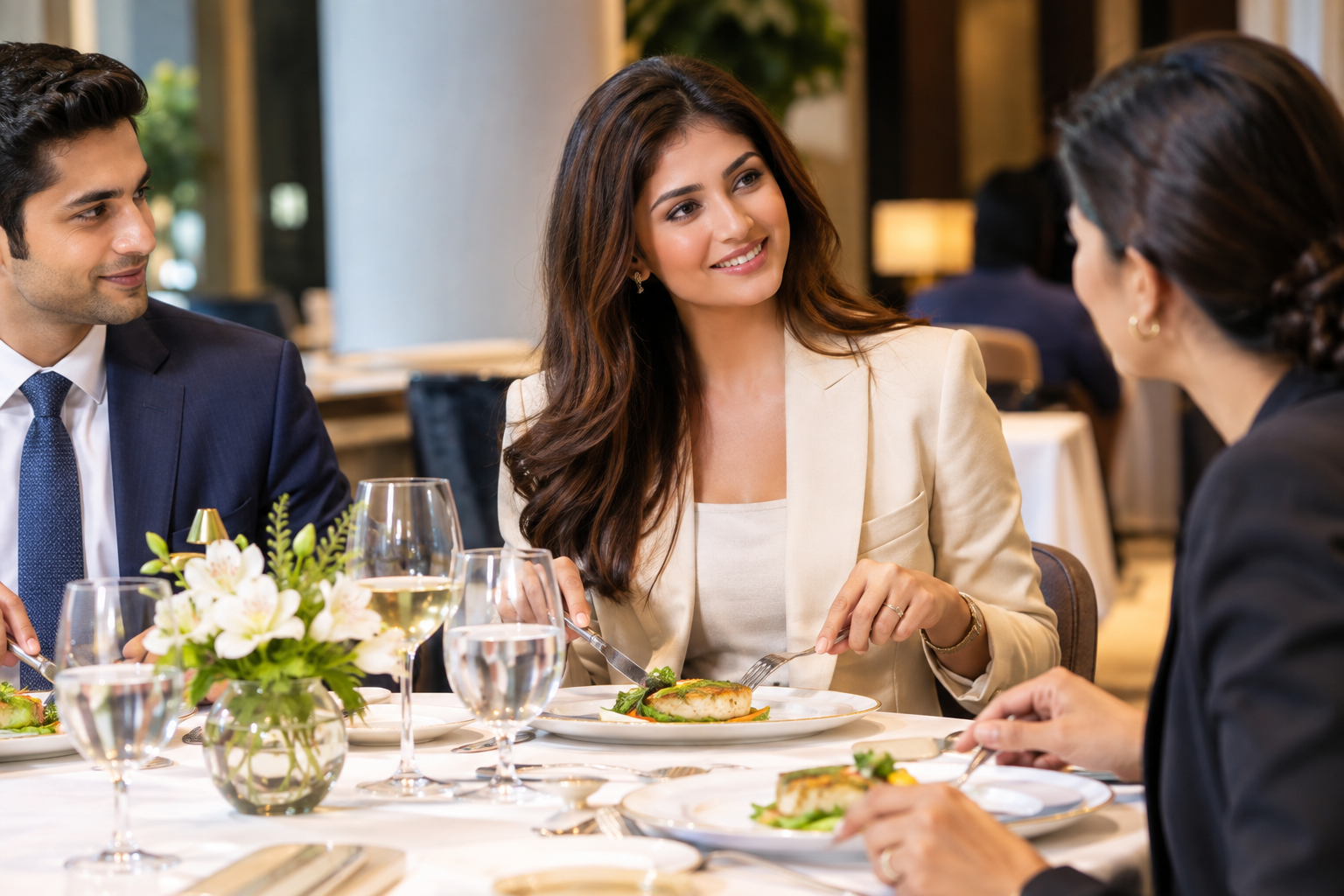
Eating etiquette classes are worth taking before a business dinner because the meal itself is being evaluated, not just the meeting agenda. A client or manager watches how you order, how you handle a fork, and how you carry a conversation between courses, and those small signals shape their reading on your professionalism just as much as your pitch does.
This article breaks down what these classes actually teach, the mistakes they help you avoid, and how to pick the right training in Mumbai before your next client dinner.
What Are Eating Etiquette Classes?
Eating etiquette classes are structured sessions that train you in the table manners, ordering habits, and dining conversation skills expected at a formal or business meal. They go beyond “which fork to use” and cover posture, pacing, host-guest roles, and how to recover gracefully from a spill or an awkward silence.
Most programs run through a real, plated meal rather than a lecture. You practice handling cutlery, folding a napkin, and reading a menu under time pressure, the same way you would at an actual client dinner. That hands-on repetition is what makes the training stick.
At Finesse, this training sits inside our broader Dining Etiquette Training program, which is built specifically around Indian and international business dining formats.
Why Do Business Dinners Carry So Much Weight in Deal-Making?
A business dinner works differently from a boardroom meeting. There’s no slide deck to hide behind, no fixed agenda, and no clear end time. That informality is exactly why it reveals more about a person’s judgment, patience, and social awareness than a scheduled call ever could.
Forbes contributor Rob Asghar, who covers business protocol, has made the case that professionals who never learned dining-table habits at home enter their careers at a real disadvantage, since command of table etiquette is often read as a proxy for character and competence. That reading happens whether or not it’s fair, which is exactly why preparation matters.
In a business dinner, three things are usually being assessed at once:
- How you treat waitstaff and other guests
- Whether you can hold a substantive conversation while managing a meal
- Whether you can stay composed if something goes wrong (a dropped napkin, a mispronounced dish, an awkward pause)
None of this shows up in a job description or a client brief. But it shows up at the table, and it’s remembered.
What Mistakes Do Untrained Professionals Make at a Business Dinner?
Most dining mistakes are not about ignorance of formal rules. They’re about small, avoidable habits that read as careless under pressure. A few show up again and again:
- Ordering the most expensive item when someone else is hosting, without reading the room first
- Talking with food in the mouth during a fast-paced negotiation conversation
- Reaching across the table instead of asking for something to be passed
- Checking a phone mid-course, even briefly, which signals disengagement
- Not knowing where the meal starts, so cutlery gets used out of order or a napkin sits untouched
- Freezing during small talk, because the conversation skill wasn’t practiced as part of the “etiquette,” only the cutlery was
Academic research on business meals backs this up. A survey of business communication students found that while most felt broadly confident, a meaningful share still reported low confidence in their actual dining skills once specifics were tested, which is a useful reminder that comfort and competence aren’t the same thing.
What Do Eating Etiquette Classes Actually Teach You?
A well-designed course covers four connected skill areas, not just cutlery placement.
Table Setting and Course Sequencing
You learn to read a full place setting at a glance: which glass is yours, which bread plate belongs to you, and how cutlery moves from the outside in as courses progress. This alone removes most of the hesitation people feel at a formal table.
Ordering and Pacing Strategy
You learn how to order in a way that matches your host’s cues, how to pace eating so you’re never mid-bite when it’s your turn to answer a question, and how to handle courses you don’t recognize without drawing attention to it.
Conversation Etiquette at the Table
This is the part most generic “table manners” content skips. Good training covers how to keep a conversation moving through silences, how to redirect a topic that’s gone off track, and how to read when the host wants to shift from small talk to business.
Cultural and Regional Dining Nuances
In Mumbai’s business environment, dinners often mix Indian, Continental, and Asian dining conventions in a single evening, sometimes at the same table. Classes cover how norms shift between a formal Indian thali service, a Continental multi-course meal, and a Pan-Asian shared-plate dinner, so you’re not caught off guard by the format.
This curriculum overlaps closely with our Etiquette Classes program and is reinforced through the same soft-skill framework we use across Personality Grooming Classes.
How Do You Choose the Right Eating Etiquette Classes in Mumbai?
Not every course is built for business use. Some are designed for weddings and social occasions, which is a different skill set entirely. When evaluating options in Mumbai, look for:
- A live, plated practice meal, not just a slideshow of cutlery diagrams
- Coverage of Indian, Continental, and Asian dining formats, since Mumbai business dinners rarely stick to one
- A conversation-skills component, not just table mechanics
- A trainer with corporate, not only social, etiquette experience
- Small group sizes, so you actually get corrected in real time rather than watching a demonstration
Finesse builds this training for working professionals through our For Corporates programs, which combine dining etiquette with the wider set of soft skills a client-facing role demands.
Real Scenarios Where Dining Training Changes the Outcome
A junior account manager invited to a client dinner who has never practiced ordering under a host’s cue will often either over-order out of nervousness or under-order out of caution, both of which stand out. A manager who has run through the scenario once in training orders confidently, matches the host’s pace, and spends the meal on the actual relationship instead of the mechanics.
The same applies to recovering from a mistake. Everyone drops a napkin or fumbles a course at some point. What separates trained professionals isn’t avoiding every slip, it’s recovering from one without breaking the flow of conversation. That composure is a trained skill, not a personality trait.
Conclusion
A business dinner tests more than your appetite. It tests your composure, your awareness of the people around you, and your ability to keep a conversation moving while managing a meal you didn’t fully control. Eating etiquette classes close that gap by turning vague nervousness into practiced, specific skills you can use at the next table you sit down at.
If you have a client dinner, a promotion dinner, or a networking event coming up, get in touch with Finesse to book a session before you need it, not after an awkward one.
FAQs
Do I really need a class, or can I just learn table manners from a video?
A video can teach you which fork to use, but it can’t correct your pacing, posture, or conversation timing in real time. Eating etiquette classes work because you practice under a trainer’s eye during an actual meal, which is what makes the behavior automatic under pressure.
Are eating etiquette classes only useful for very formal, multi-course dinners?
No. The skills apply just as much to a casual client lunch or a team dinner. The core habits, reading the room, pacing your meal, keeping the conversation on track, matter regardless of how formal the setting is.
How long does it take to feel confident after training?
Most participants notice a real difference after one structured session, since the goal isn’t memorizing rules but practicing the specific moments that usually cause hesitation. Confidence builds further with a second real-world dinner where you apply what you practiced.