
The best personality development classes in Mumbai combine three things most generic courses skip: structured feedback on how you actually come across, practice under real conditions rather than theory, and a coach who tracks your progress over weeks, not just one workshop. If you’ve ever walked out of an interview or a client pitch and thought “I know my subject, so why didn’t that land,” this is usually the gap.
This guide breaks down what these programs cover, how to compare one against another, what they cost, and what change genuinely looks like once you’re a few sessions in.
What Do Personality Development Classes in Mumbai Actually Cover?
Most people assume personality development means public speaking drills or a grooming session. In practice, a properly structured program works across four connected areas: how you look, how you behave, how you communicate, and how you show up online. Miss one of these and the other three lose credibility fast: a sharp outfit doesn’t help if your body language undercuts it two seconds later.
Appearance work covers wardrobe, colour analysis, and grooming choices that suit your skin tone, body type, and the rooms you actually walk into: a boardroom and a client dinner call for different choices. Behaviour training deals with posture, handshake, table manners, and the small social cues people read before you’ve said a word.
Communication covers voice modulation, structuring what you say, and cutting filler words without sounding stiff. Digital presence is the newest addition, and it’s often the most neglected. Your LinkedIn photo, your video-call background, and how you write a professional email all form part of your image now, whether you’ve thought about it or not.
At Finesse, this is organised around what we call the ABCD of Image: Appearance, Behaviour, Communication, and Digital Presence. A personality development program built for individuals usually moves through all four in sequence, because tackling them in isolation rarely sticks. Someone who nails a scripted answer in a mock interview but still avoids eye contact hasn’t actually solved the underlying problem. They’ve memorised a workaround.
Why Are Personality Development Classes in Mumbai in High Demand Right Now?
Demand has grown because Mumbai’s job market increasingly separates candidates on soft skills once technical qualifications are roughly equal. Two people with the same degree and the same years of experience can get very different outcomes in an interview room, a client pitch, or a promotion conversation, and the difference usually isn’t competence.
This isn’t just an anecdotal observation from trainers. The Directorate General of Employment’s National Career Service, the government’s own employment platform, now runs structured soft-skills training through partnerships like TCS iON’s “Career Skills” program, which covers corporate etiquette, presentation building, and professional communication for registered jobseekers nationwide. When a government employment portal builds out dedicated soft-skills infrastructure, it’s a fair signal that these skills have moved from “nice to have” to a recognised, trainable competency employers actively screen for.
Mumbai adds its own pressure on top of that national trend. It’s a city where you’re constantly meeting new people across a densely packed professional and social calendar: client meetings in Bandra Kurla Complex one afternoon, a networking event in Lower Parel the next evening. First impressions compound quickly here because the same social circles overlap more than people expect. A personality development course in Mumbai isn’t a vanity project in this context. It’s closer to professional infrastructure, the same way people invest in a good resume or a certification.
How Do You Choose the Right Personality Development Class in Mumbai?
Choosing well comes down to matching the format to your actual problem, not picking whichever institute has the loudest marketing. Ask yourself what specifically isn’t working: is it confidence in groups, a shaky professional wardrobe, an accent you’re self-conscious about, or something harder to name that just makes rooms feel harder than they should?
Here’s a practical comparison of what to weigh before signing up.
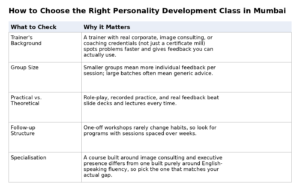
If your core issue is a wardrobe that doesn’t match the seniority you’re aiming for, a general soft-skills class won’t fix it. Programs built specifically around power dressing go deeper here. Power dressing for women is all about projecting authority, competence, and confidence through tailored, high-quality clothing.
It balances structured silhouettes, like sharp blazers and pencil skirts, with refined fabrics and a deliberate mix of neutral or bold colours, allowing you to command respect while expressing personal style. That’s a very different skill from, say, learning to hold eye contact during small talk, which is why matching the program to the actual gap matters more than picking the most popular-sounding option.
What Happens Inside a Personality Development Program?
A well-run program follows a diagnostic-then-practice structure rather than a fixed curriculum handed to everyone regardless of where they’re starting from. The first session typically involves an honest assessment: how you currently present, where the gaps are, and which of the ABCD areas need the most work.
From there, sessions build in layers. Early weeks focus on foundational habits, posture, voice projection, structured self-introductions, because these show up in every later exercise. Middle sessions move into applied practice: mock interviews, recorded presentations, simulated client meetings, and feedback that’s specific rather than general. “Be more confident” is useless advice. “You dropped your voice at the end of that sentence, which made it sound like a question instead of a statement” is something you can actually fix by next week.
Later sessions tend to focus on the professional and social contexts most relevant to the individual. A corporate professional might work through in-house corporate training scenarios like negotiation body language or handling a difficult stakeholder conversation. A personality development program for young adults preparing for campus placements or their first job typically spends more time on interview simulation and workplace etiquette, since those are the rooms they’re about to walk into for the first time.
Real Transformations: What Change Looks Like in Practice
Case studies matter more than testimonials because they show the mechanism, not just the outcome. Here are three patterns we see repeatedly across different program tracks.
A mid-level manager preparing for a client-facing promotion typically struggles with one specific thing: sounding authoritative without sounding aggressive. The fix usually isn’t more confidence in the abstract; it’s concrete voice pacing and structured pause work, practiced across several recorded sessions until it stops feeling performative and starts feeling natural.
A recent graduate heading into campus placements often has strong technical knowledge but freezes the moment a panel asks an unscripted follow-up question. Structured mock interviews with immediate, specific feedback close this gap faster than generic pep talks, because the graduate gets to fail safely and adjust before the real interview.
A business owner heading into investor or high-stakes client meetings frequently needs wardrobe and executive-presence work more than communication coaching, since their speaking skills are already solid but their visual presentation doesn’t match the seniority of the room they’re walking into. This is where soft skills training paired with image consulting tends to move faster than either piece alone.
What Does It Cost, and Is It Worth the Investment?
Cost depends heavily on format, duration, and whether the program is group-based or individual, and figures you’ll find quoted online vary enormously depending on the source and what’s actually included. Rather than anchor to a number that may not reflect what you’d actually pay, the more useful approach is to get a quote based on your specific goals, timeline, and preferred format, since a single intensive session and a multi-month coaching track aren’t comparable products.
The better question isn’t “what’s the average price” but “what’s the cost of not fixing this.” A missed promotion, a client pitch that doesn’t land, or a hiring panel that reads hesitation as lack of readiness carries its own cost, one that’s usually higher than the course fee. If you want a program mapped to your specific situation and budget, get in touch with Finesse directly for a personalized recommendation rather than guessing from a generic price list.
Common Mistakes to Avoid When Picking a Personality Development Class
A few patterns show up again and again among people who end up disappointed with a course:
- Choosing based on price alone. The cheapest option is often the most generic, with large batches and recycled slide decks.
- Skipping the trainer’s actual background. A certificate isn’t the same as real corporate, coaching, or image-consulting experience.
- Expecting a single workshop to change ingrained habits. Behaviour change needs spaced repetition, not a one-day crash course.
- Ignoring the specialisation mismatch. A course built for English fluency won’t fix a wardrobe or executive-presence problem, and vice versa.
- Not asking what a typical session actually looks like. If an institute can’t clearly describe their session structure, that’s usually a sign the program isn’t structured either.
Conclusion
Personality development isn’t about becoming a different person. It’s about closing the gap between how capable you actually are and how clearly that capability comes across in a room, an interview, or a client meeting. The right class matches your specific gap, whether that’s wardrobe, voice, body language, or digital presence, rather than handing you a generic script. Start by naming the one situation where you consistently feel like you’re underselling yourself, and use that as the filter for choosing a program.
If you’re ready to work through this with a structured, feedback-driven approach, reach out to Finesse The Finishing School in Andheri East for a personalised consultation.
Frequently Asked Questions
For most people facing interviews, client-facing roles, or leadership transitions, yes. The value comes from specific, practiced fixes, better body language, sharper communication, wardrobe suited to the room, rather than vague confidence. The return shows up in outcomes like interview offers, client trust, and promotions rather than as a feeling alone.
Most structured programs, including Finesse's ABCD framework, organise personality development into four areas: Appearance (grooming, wardrobe, colour choices), Behaviour (posture, etiquette, social cues), Communication (voice, structure, listening), and Digital Presence (LinkedIn, video calls, professional writing).
Costs vary widely by city, format, and duration, ranging from short group workshops to multi-month one-on-one coaching tracks. Because pricing depends heavily on your specific goals and timeline, the most reliable way to get an accurate figure is a direct quote from the institute rather than a generic online estimate.
Beyond the ABCD framework, trainers commonly emphasise five focus points: self-awareness, communication skills, body language, emotional intelligence, and adaptability. Together these cover how you understand yourself, express yourself, and adjust to different professional and social settings.